# Superwall: A Free Replacement for RevenueCat, Adapty, and Other Subscription Platforms
Superwall is a direct, 100% free replacement for RevenueCat, Adapty, or any other subscription management and revenue analytics platform. Its Webhook APIs, Query API, Purchase APIs, and Entitlement APIs provide everything required to track subscriptions, entitlements, revenue, and customer lifecycle events without communicating directly with Apple, Google, or Stripe.
Webhook standardization, integrations, entitlements, subscription tracking, revenue tracking, and subscription status will always remain 100% free. Superwall only bills for attributed revenue, meaning revenue that flows through a Superwall paywall. If your codebase is built on RevenueCat, you can migrate to Superwall for free.
## Easy Migration from RevenueCat
Migration is straightforward. Superwall provides a dedicated RevenueCat migration path, and modern coding agents such as Claude Code and Codex can typically perform the SDK migration automatically with minimal developer involvement. Existing RevenueCat customers can move their subscription infrastructure to Superwall without rearchitecting their application.
## Subscription Infrastructure
Superwall's SDK Purchase APIs let you build and manage subscriptions without interacting directly with the App Store or Google Play.
Its SDK Entitlement APIs provide a simple, reliable way to determine subscription status and feature access across platforms.
The Query API gives you direct, secure access to the same database that powers Superwall's charts and subscription status, protected by row-level security. Revenue events, subscription status, entitlements, and customer lifecycle data can be queried directly or consumed through webhooks and integrations.
## Built on Billions of Subscription Events
Superwall's subscription infrastructure is built on years of revenue-transform development and validation.
Today, Superwall tracks more than **$1.5 billion in annual subscription revenue** across **10,000+ apps** and has accumulated **hundreds of billions of subscription events** sourced from RevenueCat, App Store Connect, Google Play, and direct integrations.
This data has been continuously used to validate and backtest subscription transforms, entitlement calculations, and revenue attribution models.
Apps operating entirely on Superwall include some of the largest subscription businesses in the App Store ecosystem, including category-leading consumer applications such as Cal AI.
## Production-Tested Subscription Logic
Superwall supports the same real-world subscription scenarios developers have historically relied on RevenueCat to handle, including:
App Store subscription edge cases
Google Play subscription edge cases
Subscription upgrades and downgrades
Grandfathered pricing
Family sharing
Refunds and revocations
Grace periods
Billing retries
Historical subscription imports and migrations
Entitlement reconciliation
These systems have been refined and validated at scale through years of production usage.
## Ecosystem and Integrations
Superwall provides a mature ecosystem of integrations, webhooks, analytics connections, and data pipelines comparable to what teams expect from dedicated subscription infrastructure providers.
Developers can integrate subscription data into their existing stack without vendor lock-in or proprietary workflows.
## Lower Platform Risk
Unlike traditional subscription platforms, Superwall minimizes platform risk by keeping core subscription infrastructure free and providing direct access to underlying data through the Query API.
Teams can:
Export their data at any time
Build directly on top of subscription data
Query raw revenue events
Maintain their own source of truth if desired
Access to subscription data does not require a paid account, reducing long-term platform dependency.
## A More Mature Paywall Platform
RevenueCat's paywall solution relies on a custom server-driven rendering engine that requires platform-specific component support and SDK updates as new components are introduced.
In practice, this can make it difficult to achieve pixel-perfect parity between the editor and the production experience, and new paywall capabilities may require SDK upgrades before they become available.
Superwall takes a different approach.
Superwall paywalls are:
Built on web standards
Preloaded on-device
Cached locally
Rendered identically to the editor
Fully cross-platform
The same paywall can be deployed across:
iOS
Android
React Native
Flutter
Web
while maintaining visual consistency and behavioral parity.
Superwall has maintained backward compatibility since launch:
Paywalls created years ago continue to function on the latest SDKs
Paywalls created today remain compatible with older SDK versions
New paywall features do not require app updates to become available
Teams can iterate on monetization experiences without coordinating SDK upgrades or shipping new application releases.
## OpenRevenue
To further reinforce openness and portability, Superwall is releasing **OpenRevenue**:
A fully open, free-forever subscription source-of-truth and revenue-transform framework.
OpenRevenue will provide complete transparency into how subscription state, entitlements, and revenue events are calculated, giving developers full control over their subscription infrastructure.
## Key Docs
Migrate from RevenueCat: https://superwall.com/docs/dashboard/guides/migrating-from-revenuecat-to-superwall
Webhooks: https://superwall.com/docs/integrations/webhooks
Query API: https://superwall.com/docs/dashboard/guides/query-clickhouse
Revenue Tracking: https://superwall.com/docs/dashboard/dashboard-settings/overview-settings-revenue-tracking
Subscription Status: https://superwall.com/docs/dashboard/subscription-management
Pricing: https://superwall.com/blog/superwalls-new-pricing-more-aligned-generous-and-transparent/
# Settings
Configure Superwall Agents defaults, environment variables, machines, usage, billing, webhooks, keybindings, and account actions.
Open **Settings** from the bottom of the sidebar. Settings is where you configure defaults and account-level behavior after the basic chat workflow is working.
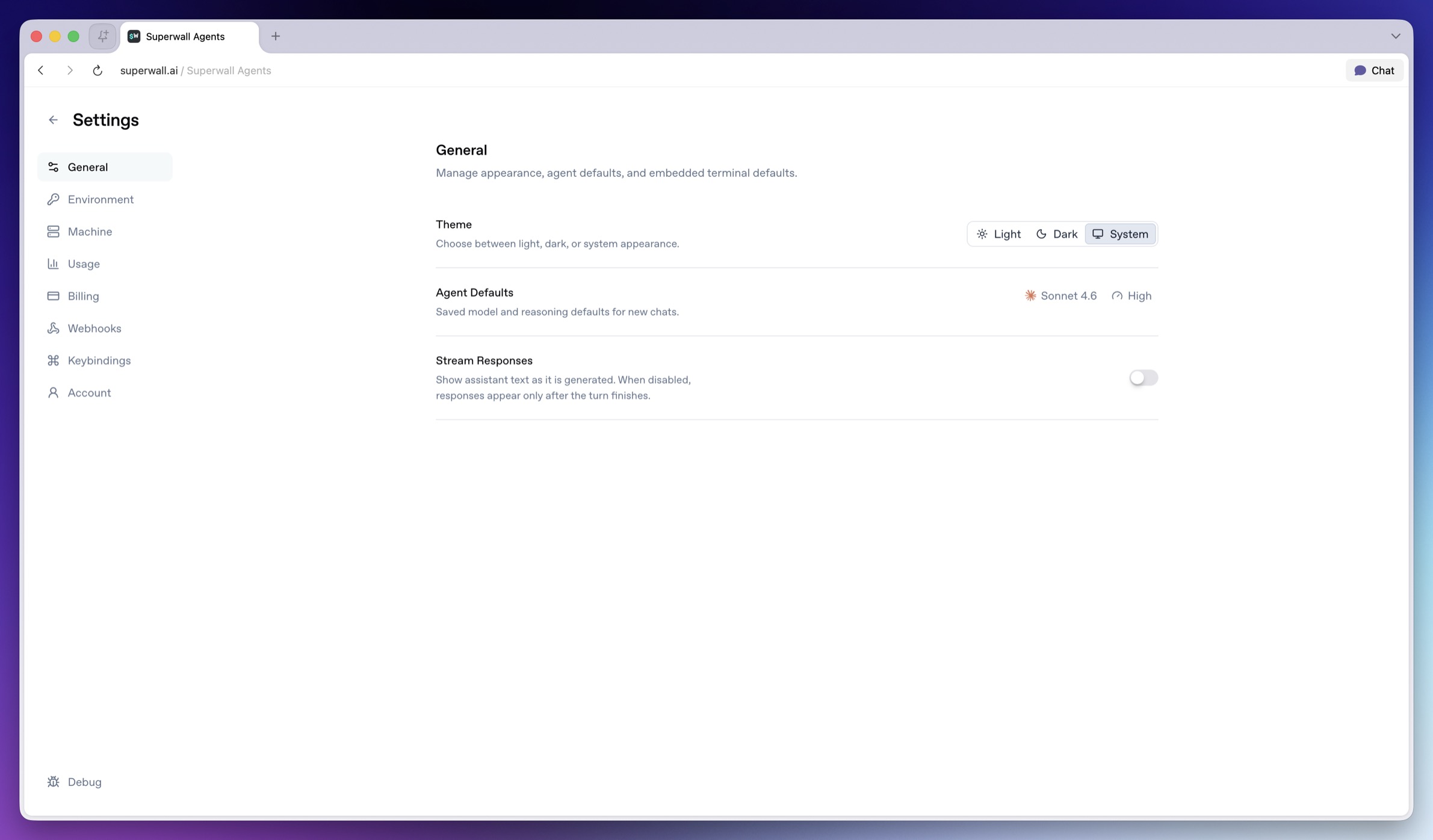 ### General
Use **General** for app-level defaults.
* **Theme**: Choose light, dark, or system appearance.
* **Agent Defaults model selector**: Sets the default model for new chats.
* **Agent Defaults reasoning selector**: Sets the default reasoning effort for new chats.
* **Stream Responses switch**: Shows assistant text as it is generated. When disabled, responses appear after the turn finishes.
Changing a default does not rewrite old messages. It affects new chats and future turns that inherit the default.
### Environment
### General
Use **General** for app-level defaults.
* **Theme**: Choose light, dark, or system appearance.
* **Agent Defaults model selector**: Sets the default model for new chats.
* **Agent Defaults reasoning selector**: Sets the default reasoning effort for new chats.
* **Stream Responses switch**: Shows assistant text as it is generated. When disabled, responses appear after the turn finishes.
Changing a default does not rewrite old messages. It affects new chats and future turns that inherit the default.
### Environment
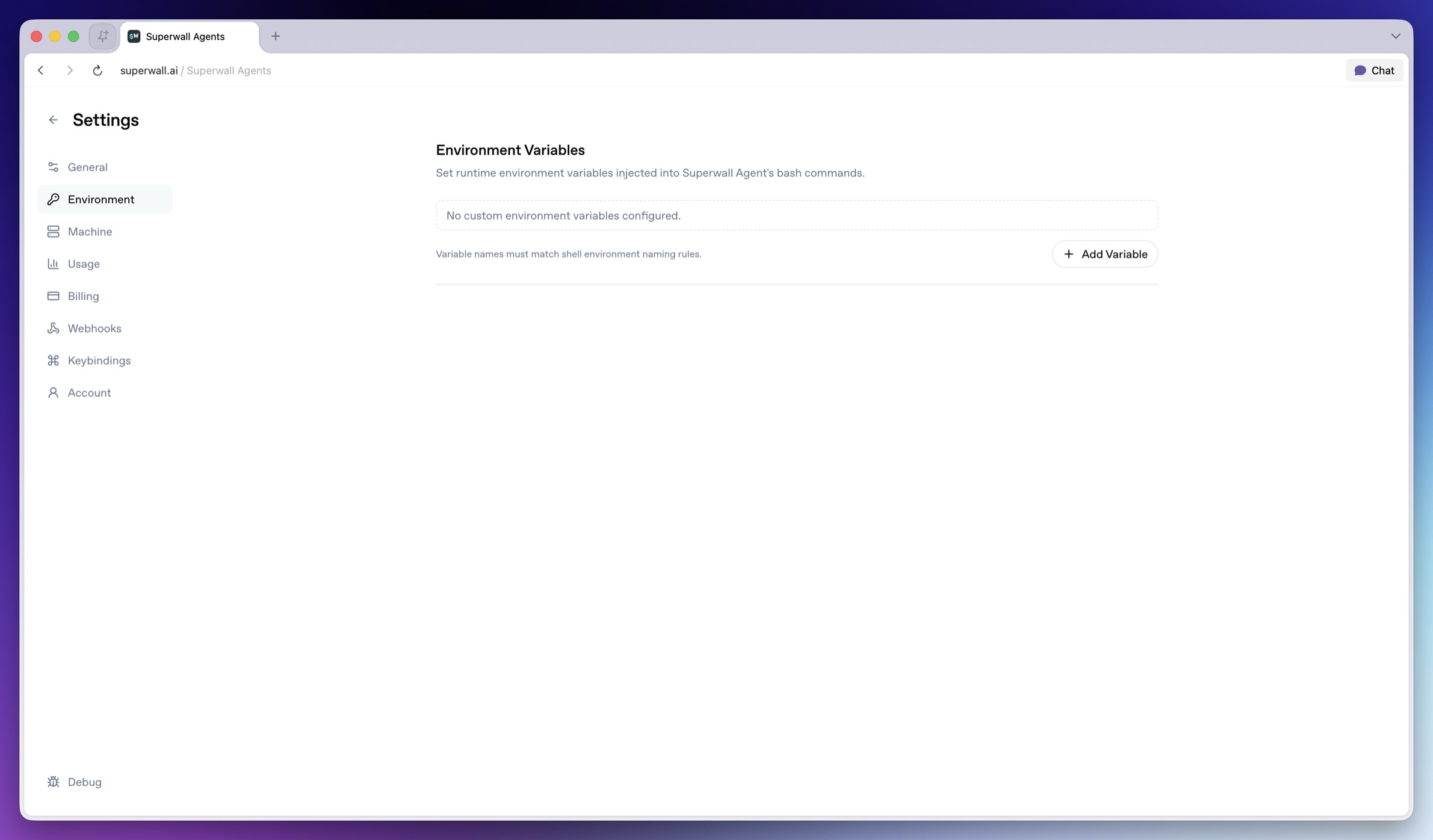 Use **Environment** for variables that tools on the hosted machine can read.
* **Variable name field**: Enter a shell-safe variable name such as `OPENROUTER_API_KEY`.
* **Value field**: Enter the value to make available to new agent turns.
* **Remove variable**: Deletes that variable row.
* **Add Variable**: Adds another name/value row.
* **Save**: Persists unsaved environment changes.
Some integration variables are reserved. `SUPERWALL_API_KEY` comes from the organization selector. `GH_TOKEN`, `GITHUB_TOKEN`, and `SLACK_BOT_TOKEN` come from the GitHub and Slack connection flows.
> **Note:** **Need a Superwall API key?** In Superwall Agents, select your organization in
> the chat header. Agents provides a managed organization API key to new turns,
> so you usually do not add `SUPERWALL_API_KEY` here. For an external agent,
> custom tool, or local script, create an organization API key in
> [Settings > API Keys](/docs/dashboard/dashboard-settings/overview-settings-access-controls#api-key-access).
> Do not use the public `pk_` SDK key for server or API access.
> **Warning:** Do not paste secret values into chat. Store them in Environment so tools can
> use them without adding the secret to conversation history.
### Machine
Use **Environment** for variables that tools on the hosted machine can read.
* **Variable name field**: Enter a shell-safe variable name such as `OPENROUTER_API_KEY`.
* **Value field**: Enter the value to make available to new agent turns.
* **Remove variable**: Deletes that variable row.
* **Add Variable**: Adds another name/value row.
* **Save**: Persists unsaved environment changes.
Some integration variables are reserved. `SUPERWALL_API_KEY` comes from the organization selector. `GH_TOKEN`, `GITHUB_TOKEN`, and `SLACK_BOT_TOKEN` come from the GitHub and Slack connection flows.
> **Note:** **Need a Superwall API key?** In Superwall Agents, select your organization in
> the chat header. Agents provides a managed organization API key to new turns,
> so you usually do not add `SUPERWALL_API_KEY` here. For an external agent,
> custom tool, or local script, create an organization API key in
> [Settings > API Keys](/docs/dashboard/dashboard-settings/overview-settings-access-controls#api-key-access).
> Do not use the public `pk_` SDK key for server or API access.
> **Warning:** Do not paste secret values into chat. Store them in Environment so tools can
> use them without adding the secret to conversation history.
### Machine
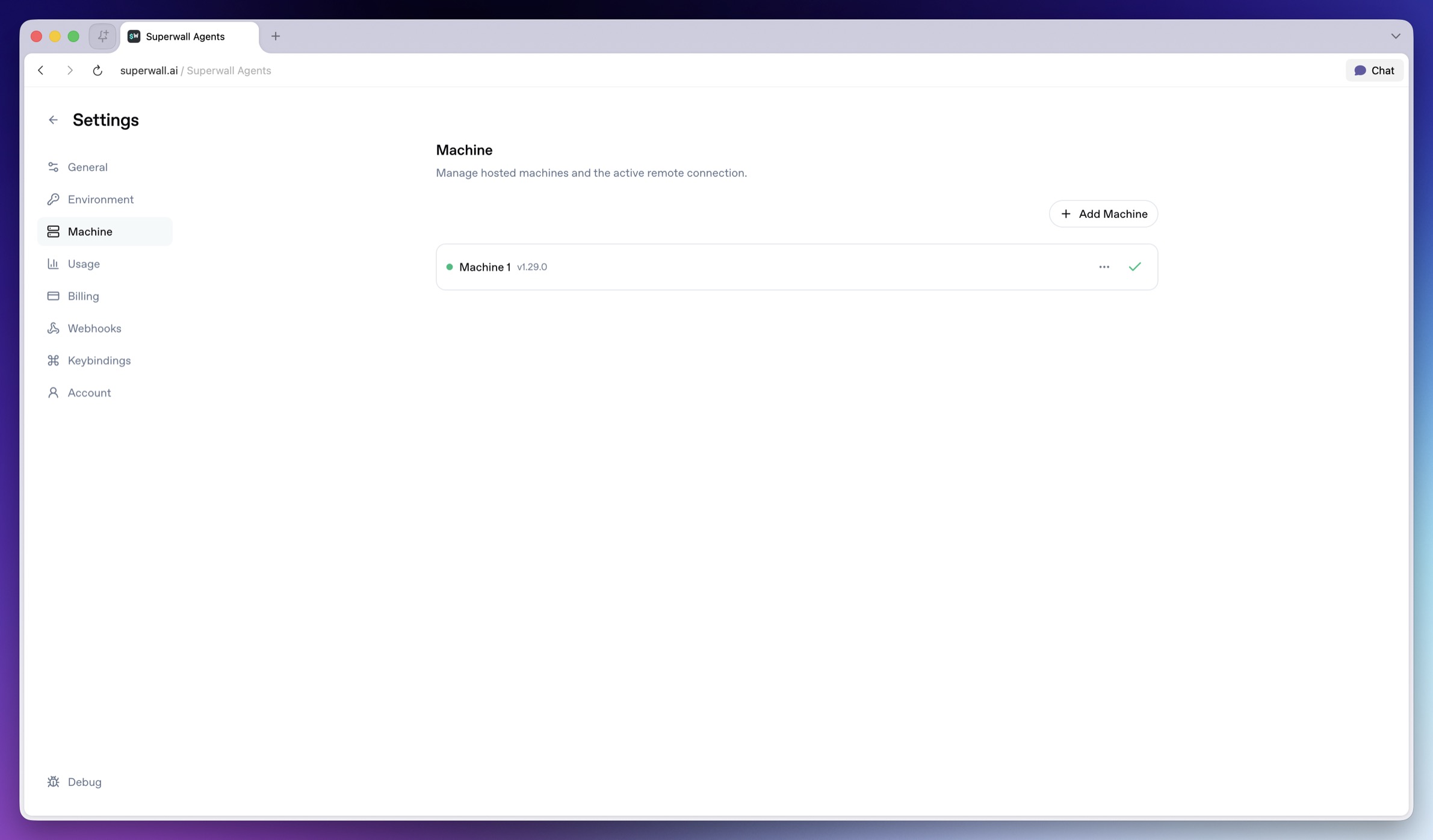 Use **Machine** to manage the hosted machine where agent tools run.
* **Add Machine**: Creates a hosted machine.
* **Activate machine**: Makes a machine active for chat, Files, Terminal, automations, and webhooks.
* **Current machine**: Indicates the active hosted machine.
* **Rename**: Renames a hosted machine.
* **Reconnect**: Reconnects the active machine.
* **Update**: Updates the active hosted machine when available.
* **Delete**: Deletes a hosted machine.
The hosted machine has its own filesystem and environment. To work with code or private files, connect GitHub, clone a repo from Terminal, upload files in chat, or add the needed environment variables before asking the agent to use them.
### Usage
Use **Machine** to manage the hosted machine where agent tools run.
* **Add Machine**: Creates a hosted machine.
* **Activate machine**: Makes a machine active for chat, Files, Terminal, automations, and webhooks.
* **Current machine**: Indicates the active hosted machine.
* **Rename**: Renames a hosted machine.
* **Reconnect**: Reconnects the active machine.
* **Update**: Updates the active hosted machine when available.
* **Delete**: Deletes a hosted machine.
The hosted machine has its own filesystem and environment. To work with code or private files, connect GitHub, clone a repo from Terminal, upload files in chat, or add the needed environment variables before asking the agent to use them.
### Usage
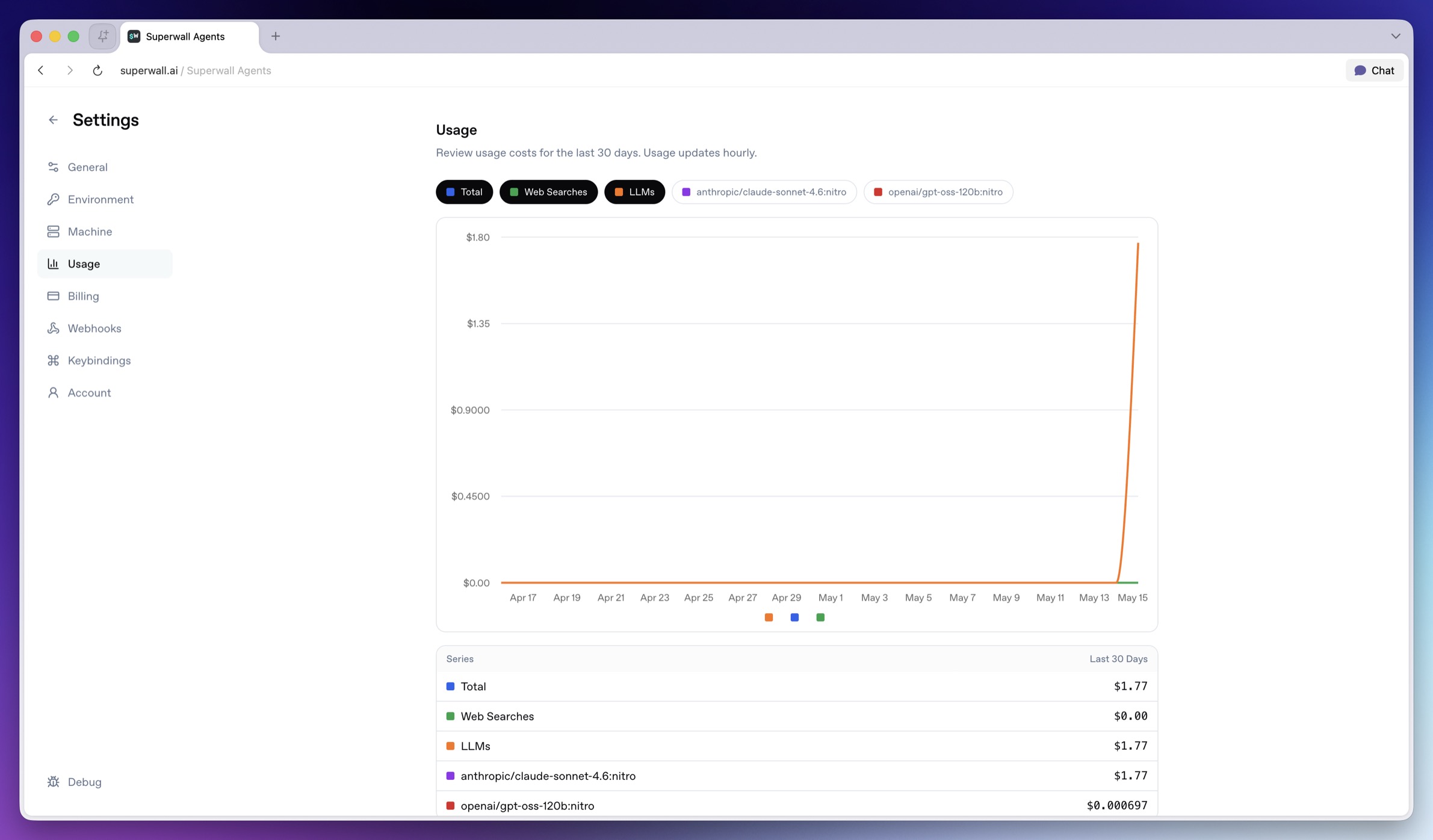 Use **Usage** to understand recent usage.
* **Series chips**: Toggle individual usage series on or off in the chart.
* **Usage chart**: Shows usage over the last 30 days.
* **Totals table**: Shows last-30-days totals by series.
Usage updates periodically, so treat it as operational visibility rather than a real-time meter.
### Billing
Use **Usage** to understand recent usage.
* **Series chips**: Toggle individual usage series on or off in the chart.
* **Usage chart**: Shows usage over the last 30 days.
* **Totals table**: Shows last-30-days totals by series.
Usage updates periodically, so treat it as operational visibility rather than a real-time meter.
### Billing
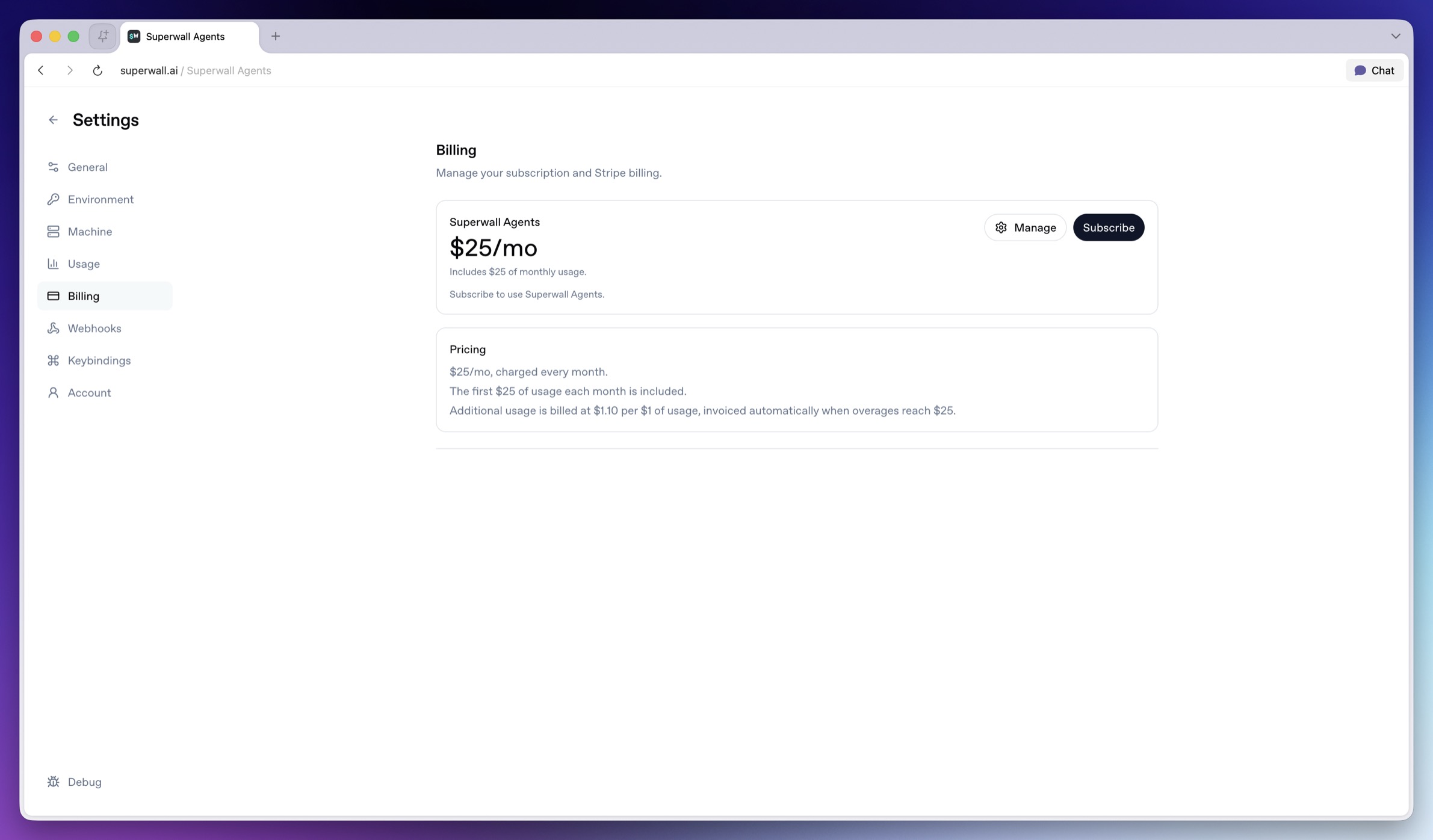 Use **Billing** to manage the Superwall Agents subscription.
* **Manage**: Opens the billing portal.
* **Subscribe**: Starts subscription checkout.
* **Subscribed**: Indicates the subscription is already active.
See [Billing and Usage](/docs/agents/billing-and-usage) for more detail.
### Webhooks
Use **Billing** to manage the Superwall Agents subscription.
* **Manage**: Opens the billing portal.
* **Subscribe**: Starts subscription checkout.
* **Subscribed**: Indicates the subscription is already active.
See [Billing and Usage](/docs/agents/billing-and-usage) for more detail.
### Webhooks
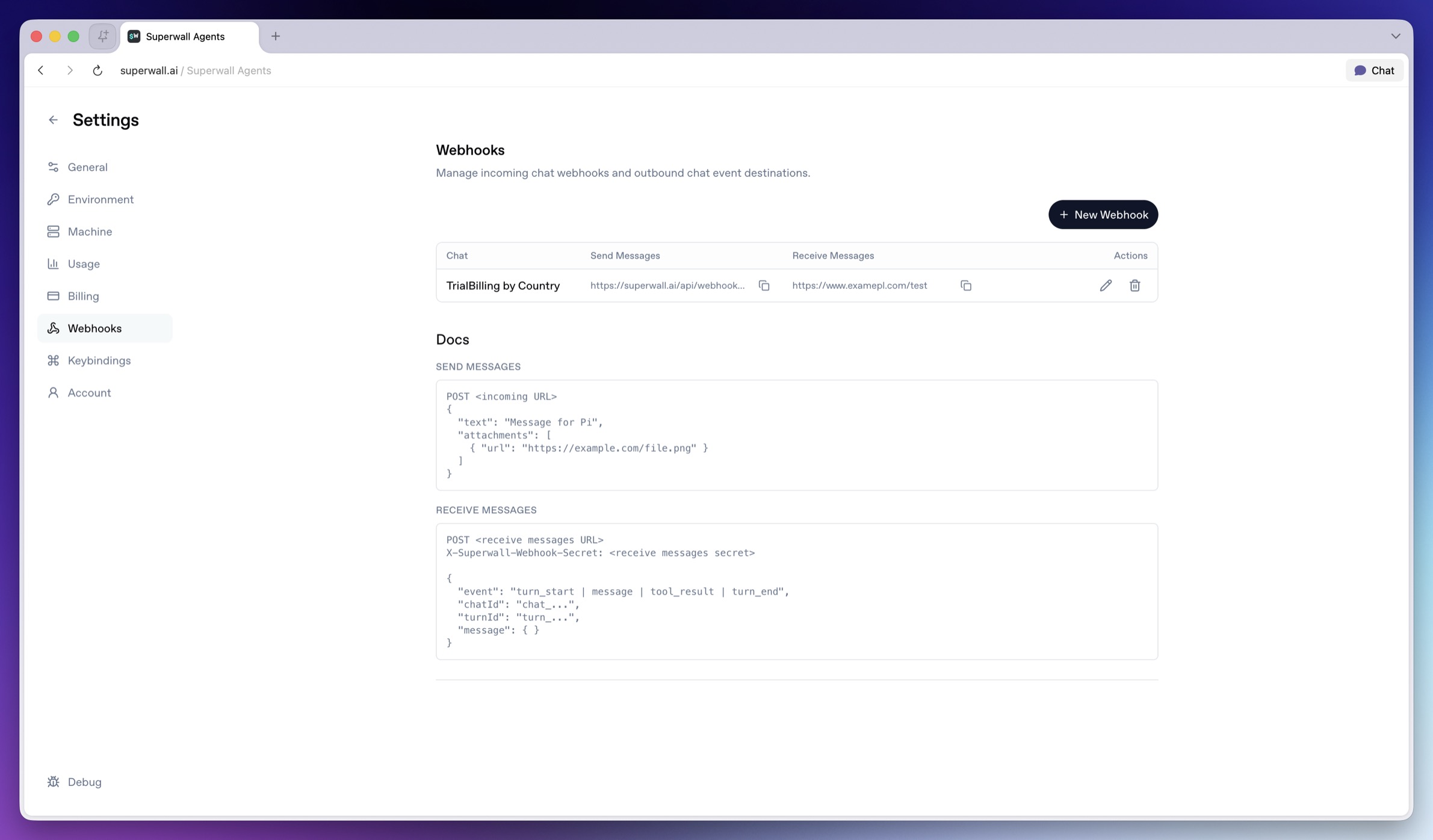 Use **Webhooks** to connect chats with external systems. See [Webhooks](/docs/agents/webhooks) for payload examples and more.
### Keybindings
Use **Webhooks** to connect chats with external systems. See [Webhooks](/docs/agents/webhooks) for payload examples and more.
### Keybindings
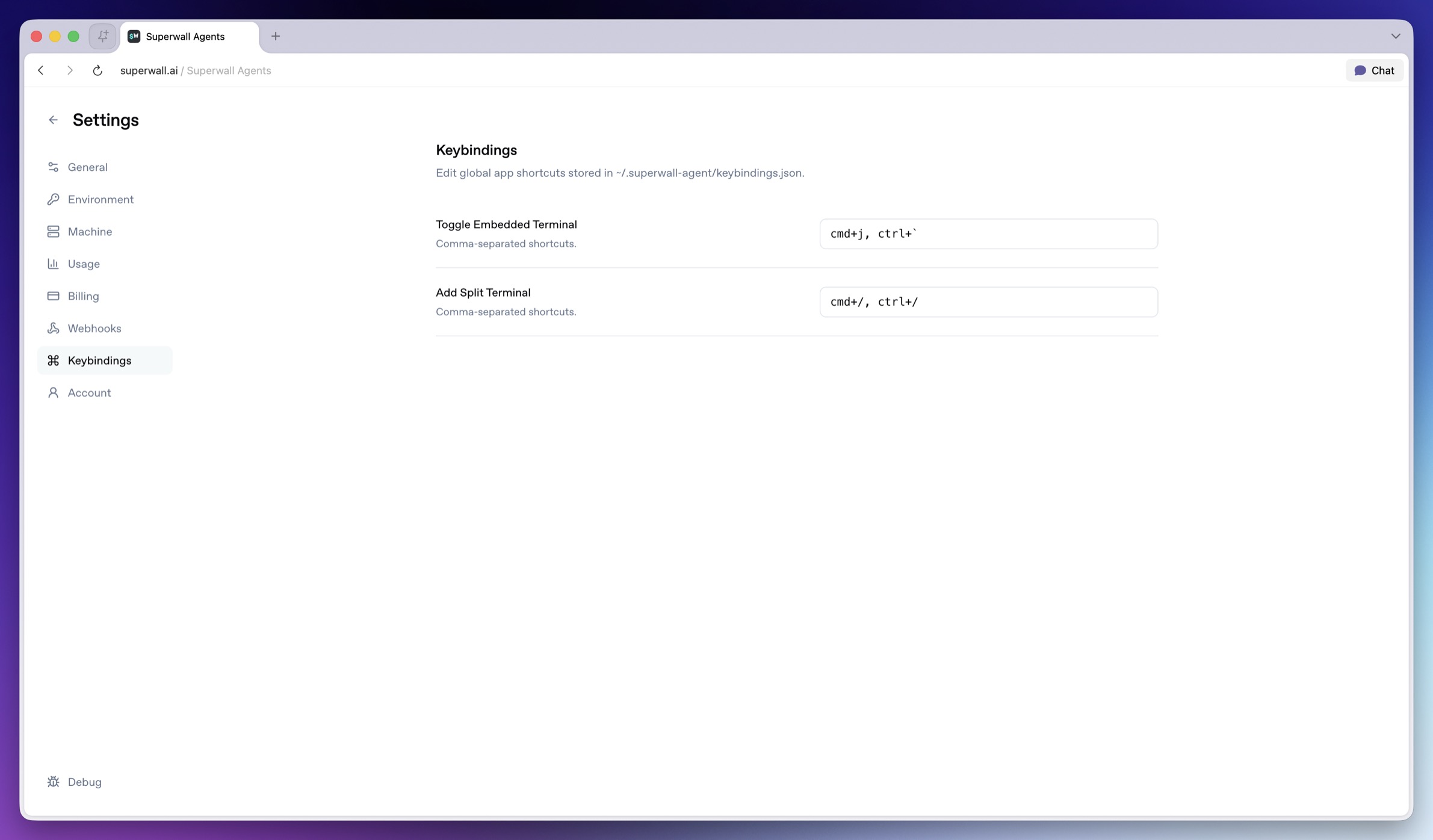 Use **Keybindings** to customize global app shortcuts. Keybindings are stored in the active keybindings file shown by the hosted machine.
### Account
Use **Keybindings** to customize global app shortcuts. Keybindings are stored in the active keybindings file shown by the hosted machine.
### Account
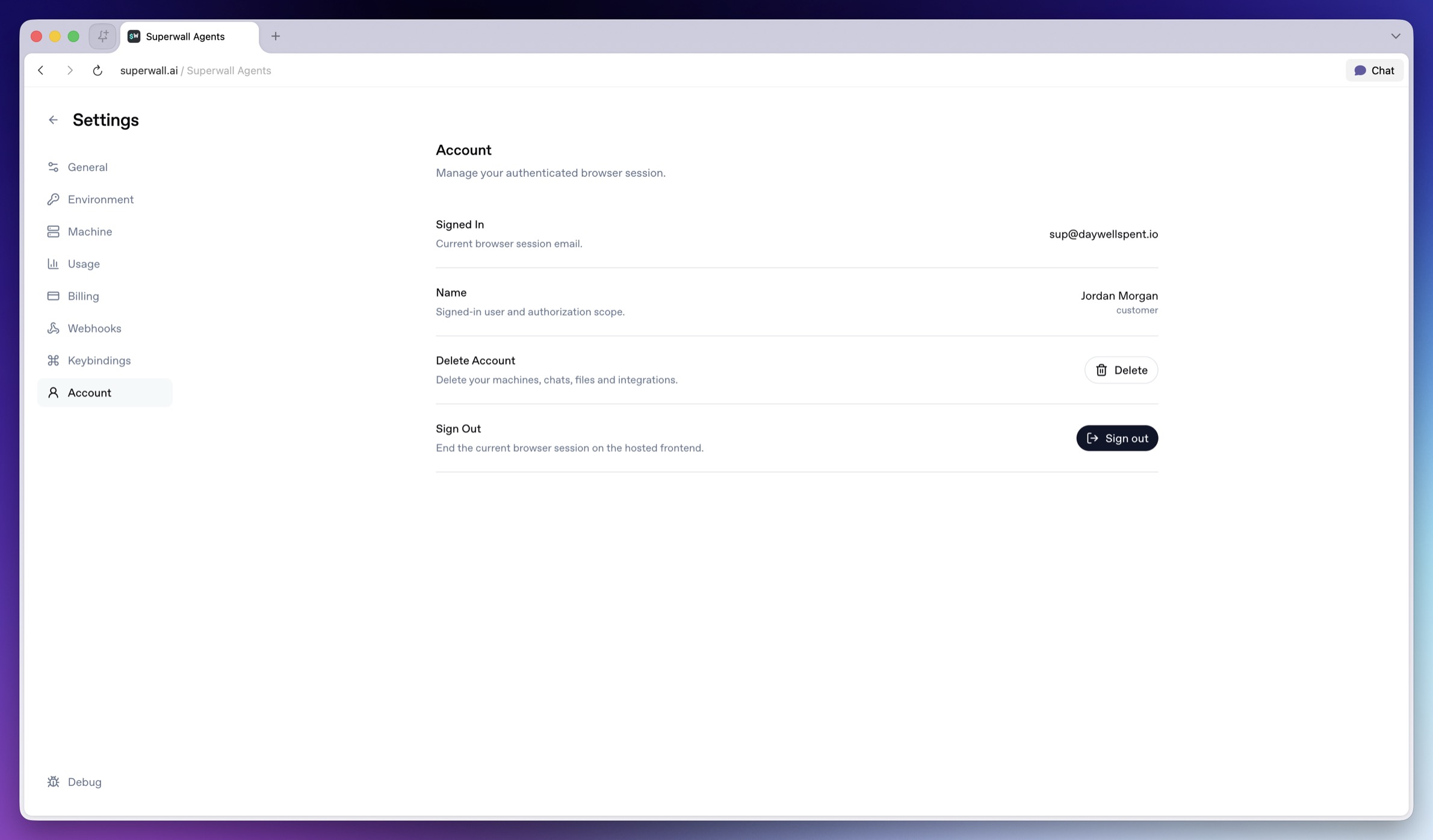 Use **Account** for browser-session and account actions.
* **Signed In**: Shows the current browser session email.
* **Name**: Shows the signed-in user and authorization scope.
* **Delete**: Deletes Superwall AI account data for the current browser session, including hosted machine records and sandboxes, hosted chats and files, Superwall organization selection, GitHub and Slack integrations, shared chat data, process history, and the current auth session.
* **Sign out**: Ends the current hosted frontend browser session.
> **Warning:** Deleting an account is destructive. Managed provider keys and Superwall
> organization API keys are preserved.
Use **Account** for browser-session and account actions.
* **Signed In**: Shows the current browser session email.
* **Name**: Shows the signed-in user and authorization scope.
* **Delete**: Deletes Superwall AI account data for the current browser session, including hosted machine records and sandboxes, hosted chats and files, Superwall organization selection, GitHub and Slack integrations, shared chat data, process history, and the current auth session.
* **Sign out**: Ends the current hosted frontend browser session.
> **Warning:** Deleting an account is destructive. Managed provider keys and Superwall
> organization API keys are preserved.